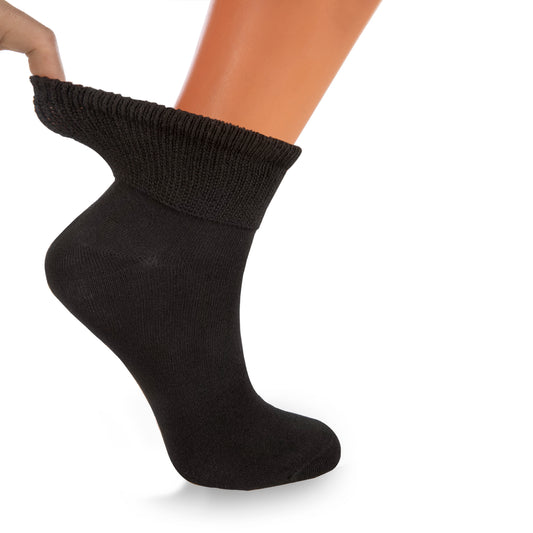
Search for diabetic socks and you get a wall of products that all promise the same three words: non-binding, seamless, moisture-wicking. Nobody explains what any of them mean. This guide does, so you can tell a genuinely different sock from a normal sock with a label on it.
One thing first, and we will say it once plainly: we sell socks, we are not doctors. If you have diabetes, neuropathy, swelling, or any foot problem you are worried about, your doctor or podiatrist is the person to ask what you should be wearing. What follows is about how socks are made, not about treating anything.
What non-binding actually means
Every sock has to stay up somehow. Most do it with a band of elastic at the top that grips the leg. On a standard sock that band is noticeably tighter than the rest of the sock, which is why you can often see a ring pressed into your leg when you take them off at the end of the day.
A non-binding sock does it differently. Instead of a tight elastic band, the top is knitted with the stretch spread through a wider section of ribbing, so the sock holds position over several inches rather than gripping hard in one narrow line. The result is a top that stays up without leaving a mark. Non-binding tops are gentler on swollen ankles than a tight cuff, which is the main reason people look for them, but ask your doctor whether they are right for you.
That is the whole trick, and it is a real construction difference, not marketing. You can feel it: roll the top of a non-binding sock between your fingers and it is soft and even, with no dense rubbery band running through it.
The other three features worth checking
A flat or seamless toe
The toe seam is where most socks are joined, and on a cheap sock that join is a raised ridge sitting right across the tops of your toes. Inside a shoe, over a few thousand steps, a ridge is a rubbing point. A flat or hand-linked toe seam removes it. This matters for anyone, but it matters most if your feet are less sensitive than they used to be and you would not necessarily notice a rub starting.
Moisture-wicking fiber
Damp feet are uncomfortable and damp socks are worse. Cotton absorbs moisture and holds it; a blend that moves moisture away from the skin and lets it evaporate keeps the foot drier. Our diabetic ankle socks are a soft, moisture-wicking cotton, and if you want the same behavior in a dress sock, bamboo socks do a similar job because bamboo rayon is naturally absorbent and dries quickly.
How much padding
Some comfort socks are thin, some are cushioned underfoot. Neither is better in the abstract. What matters is whether the sock still fits properly inside the shoe you actually wear. A thick sock in a snug shoe just moves the pressure somewhere else.
Non-binding is not compression
This is the point people most often get wrong. Compression socks are designed to squeeze, usually harder at the ankle and less further up, to help with circulation. Non-binding socks are designed to do the opposite: to hold on with as little pressure as possible. They are not interchangeable, and if you have been told to wear compression, a non-binding sock is not a substitute. Again, that is a conversation for your doctor.
Who else buys them
Plenty of people who do not have diabetes buy non-binding socks. Anyone whose ankles swell on long flights or in hot weather, anyone who stands all day at work, anyone in later pregnancy, and anyone who simply dislikes the feeling of a tight cuff. If you have ever come home and immediately taken your socks off because of the mark they left, this is the style you have been looking for.
Getting the size right
A non-binding sock still needs to fit. Too small and you lose the benefit, because a sock stretched to its limit grips harder everywhere. Our non-binding diabetic ankle socks are unisex and come in two ranges, 5-7 and 9-11, in 3-pair packs, and they are made in the USA. If you are unsure which range you are in, our sock size guide explains how the numbers on the pack map to US shoe sizes.
Making them last
The soft top is the part that wears out first, and heat is what kills it. Wash cool, dry on low or flat, and keep fabric softener away from them, because it coats the fibers and leaves the ribbing slack. Buy them in packs and rotate through the pack rather than wearing one favorite pair into the ground; socks last considerably longer when they get a rest between wears.
Where to start
Browse the range in diabetic and comfort socks, or if you want the same soft, breathable feel in a dress or crew sock, look at men's socks and women's socks. Every order ships free within the US from our base in Texas, and anything unworn can come back within 30 days.